


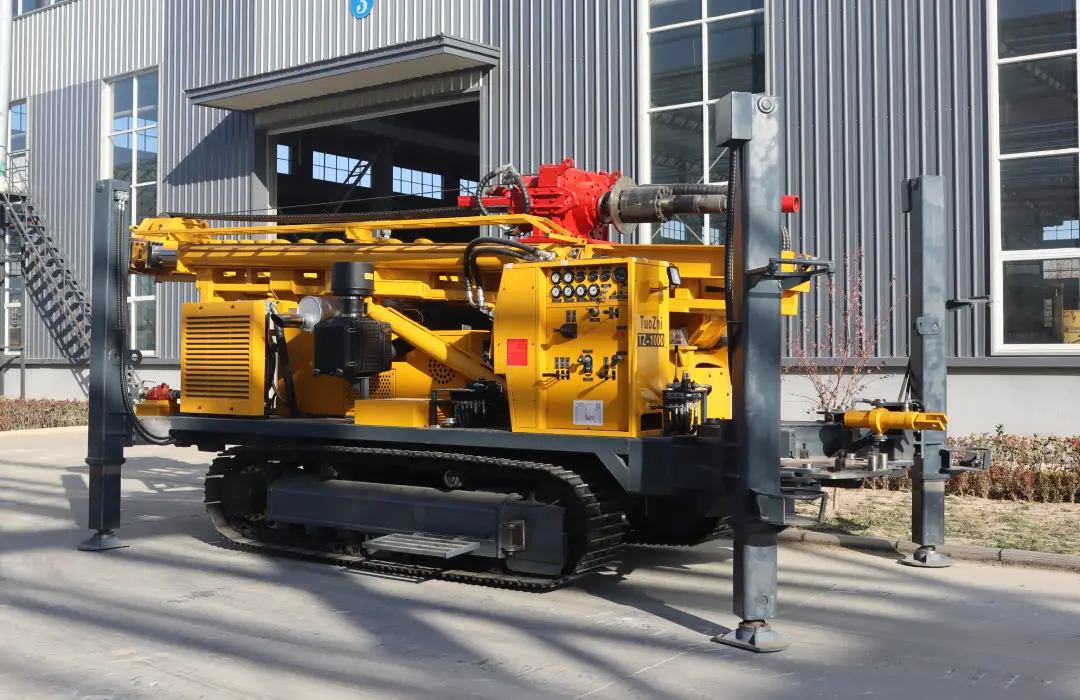
In water well construction, agricultural water extraction, and engineering drilling, the selection of a crawler water well drilling rig directly determines construction efficiency, equipment lifespan, and overall investment costs.
Many users, when purchasing water well drilling rigs, often only focus on price or maximum drilling depth, but in actual use, they find that efficiency is low, malfunctions are frequent, and maintenance costs are prohibitively high.
In fact, a truly efficient and durable Crawler water well drilling rig depends on multiple comprehensive factors, not just the numbers on the specifications sheet.
This article will systematically explain how to choose the right crawler water well drilling rig for your needs, considering factors such as geological conditions, key parameters, structural design, construction efficiency, and long-term operating costs.
I. There is no such thing as a “universal” crawler water well drilling rig; different geological formations require completely different equipment. Common geological formations mainly include:
Clay layers, sand layers
Clay mixed with gravel and pebbles
Hard rock layers such as limestone and granite
Complex mixed geological formations
If the main drilling formation consists of soft soil or cohesive soil, mud drilling is more suitable, requiring higher stability and hydraulic system performance from the drilling rig.
In hard rock or fractured rock formations, the rig’s performance depends more on the matching of torque, lifting force, and down-the-hole hammer system.
Unclear geological conditions are the primary reason for choosing the wrong drilling rig.
II. Key technical parameters are far more important than “horsepower”
- Torque determines the cutting ability of the drill pipe in complex geological formations, especially in areas with many stones or hard spots. Stable torque output can effectively reduce drill pipe jamming and wear.
- Lifting force is directly related to the safety of deep well drilling. In cases of borehole collapse or drill pipe jamming, sufficient lifting force can significantly reduce construction risks.
- For an efficient and durable water well drilling rig, the hydraulic system, rotary system, and power system must be highly matched.
An unstable hydraulic system is often the root cause of low efficiency and frequent malfunctions.
III. Structural design determines durability and maintenance costs
The durability of a Crawler water well drilling rig, in addition to its core configuration, is closely related to its structural design.
- Tracked drilling rigs are more suitable for complex terrain and field construction, offering strong stability; wheeled drilling rigs are more suitable for areas with good road conditions, offering high transfer efficiency. 2. A well-designed drill rig structure can effectively reduce construction vibrations and minimize impact on critical components, thereby extending the equipment’s service life.
- Durability is not just about “not breaking down,” but also about “ease of maintenance.”
The filtration system, lubrication point layout, and ease of replacing commonly worn parts all directly affect long-term operating costs.
IV. Construction Efficiency ≠ Drilling Speed, but “Continuous Stability”
Continuous operation capability
Low failure rate
Daily maintenance time
Downtime frequency
An efficient water well drilling rig should have the following characteristics:
Stable drilling rhythm, not prone to slipping
Smooth drill pipe connection, simple operation
Adaptable to continuous operation under different working conditions
No overheating or oil leakage during long-term operation
These factors are often more important than the “fastest drilling speed.”
V. The Supporting Solution is Equally Crucial
A water well drilling rig is not a single piece of equipment, but part of a system solution, including:
Drill pipe specifications and length
Drill bit type (alloy drill bits, down-the-hole hammers, etc.)
Air compressor or mud pump configuration
Auxiliary tools and spare parts supply
Even if the drilling rig itself performs excellently, an unsuitable supporting solution will severely affect construction results.
Therefore, when purchasing a water well drilling rig, you should confirm whether the equipment supports commonly used consumables and parts standards in your area.
VI. Considering “Cost-Effectiveness” from a Long-Term Perspective
A truly cost-effective water well drilling rig is not the one with the lowest price, but the one that offers:
Long service life
Low failure rate
Easily available spare parts
Controllable maintenance costs
For drilling teams and engineering companies, the benefits of stable operation often far outweigh the initial savings in procurement costs.
Conclusion: Choosing the Right Water Well Drilling Rig is Essentially Choosing the Right Solution
How to choose an efficient and durable water well drilling rig?
The answer is not complicated – start from the geological conditions, focus on core parameters, pay attention to the structure and supporting solutions, and consider long-term operating costs.
Only by truly understanding the construction needs and selecting the equipment based on actual working conditions can the water well drilling rig continuously create value throughout its entire service life.
Articles connexes

 FR
FR  EN
EN  ES
ES  ID
ID
Poster un commentaire